
Confirmed Keynote
Fun, Facts, and Fiction: AI in Digital Design & Engineering
Kim Lauenroth
From concept to prototype in hours – but at what cost and quality? Kim Lauenroth shares an honest look at what AI actually delivers across the design and engineering lifecycle: the excitement, the evidence, and the myths.
- Fun – Structured templates + AI = hours from idea to testable prototype. New possibilities, new questions.
- Facts – Studies show: the greatest value comes from balancing effort across the full lifecycle, not just accelerating one phase.
- Fiction – AI is no magic lamp. It amplifies what we put in – good and bad. Methodological maturity decides the outcome.
Takeaway: AI doesn't replace expertise. It strengthens it.
𝗪𝗵𝘆 𝘁𝗵𝗶𝘀 𝗲𝘃𝗲𝗻𝘁 𝗺𝗮𝘁𝘁𝗲𝗿𝘀 𝗻𝗼𝘄
Many organizations already use AI in isolated parts of their workflow. In many cases, however, AI only accelerates one phase, such as coding, while new bottlenecks appear elsewhere. This event takes a broader view. It shows how AI can support the full design and engineering lifecycle in a way that is practical, human-centered, and effective across disciplines.
Your benefits
-
12 hours of focused learning
-
End-to-end perspective in design & engineering
-
Joint expertise from IREB and iSAQB
-
Strategy plus hands-on tutorials
From idea to production: the full lifecycle in one day
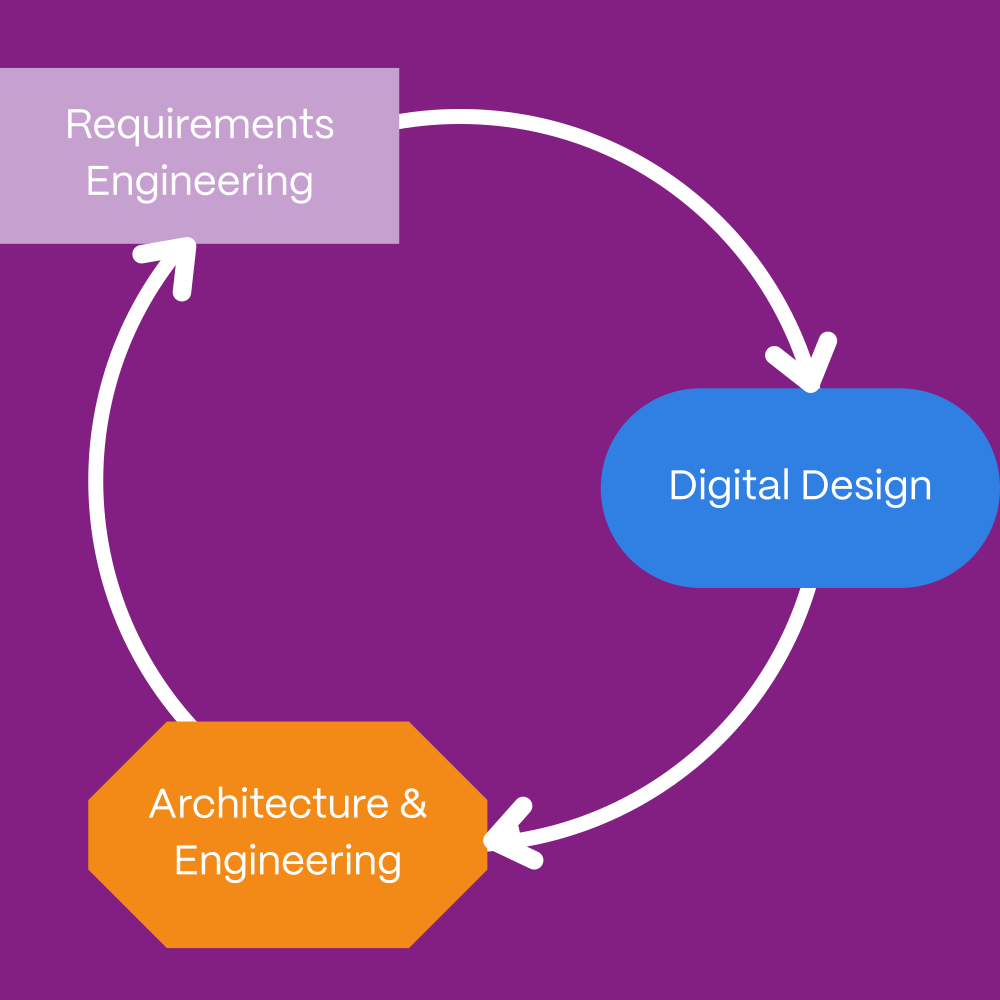
The program covers the key stages of modern digital product and system development. Topics include requirements engineering & analysis, digital design & prototyping, software architecture & engineering, as well as quality assurance of the final product. The event also creates space for discussion about challenges, success factors, and the organizational conditions needed for end-to-end AI maturity.
Who should attend
This event is for professionals who shape, build, or improve digital solutions and systems. It is especially relevant for requirements engineers, software architects, developers, UX and UI professionals, product managers, project leads, QA specialists, and engineering leads. It is particularly valuable for anyone who wants to use AI not in isolation, but across teams, disciplines, and the full delivery lifecycle.
Conference Programme · October 14, 2026 · Graz, Austria
| Time | Track | Session | Speaker | |
|---|---|---|---|---|
| Morning Session | ||||
| ☕ 09:00–09:15 · Registration & Welcome Coffee | ||||
| 09:15–10:15 | IREB Keynote | Fun, Facts, and Fiction: AI in Digital Design & Engineering | Dr. Kim Lauenroth · IREB | |
|
Abstract
AI is transforming how we design and engineer digital solutions — but the real question isn't whether it's powerful. It's whether we're mature enough to use it well.
Fun: In just hours, structured templates carried Kim through many iterations between concept and code, resulting in a strong prototype ready for end-user tests. Genuinely exciting — but also humbling: AI costs can run high. The key? Having fun while staying critical. Facts: Reliable research is still scarce, but early findings reveal a consistent pattern: balanced effort across the entire design and engineering lifecycle has always been the sweet spot. Accelerating just coding or just design creates bottlenecks elsewhere. End-to-end thinking matters more than ever. Fiction: Many people expect AI to be the one tool that solves every problem. Kim's experiments show a different reality: AI amplifies what we give it — good ideas and bad ones alike. You must master both your AI and your methodology to judge quality. Takeaway: AI doesn't replace expertise. It's a partner on equal footing. AI brings speed and scale; you bring judgment and methodological depth. The stronger your fundamentals, the more powerful the collaboration becomes.
Speaker Bio
Dr. Kim Lauenroth is Chairman of IREB e.V. and has been designing digital solutions since 2011. Since 2022, he has been teaching digital design at Dortmund University of Applied Sciences and Arts. As a co-initiator of the Digital Design Manifesto, he has been advocating for years for digital design as a distinct profession. Kim studied computer science, business administration, and psychology, received his Ph.D. in 2009 on requirements engineering for product lines, and has authored textbooks and more than 40 publications.
|
||||
| ☕ 10:15–10:45 · Coffee Break & Networking | ||||
| 10:45–11:30 | RE & Design | AI in Requirements Engineering: More Than Hype – Less Than Magic | Leonie Hahn · Deloitte | |
|
Abstract
Artificial Intelligence is often seen as a game changer for Requirements Engineering, promising faster delivery, better quality, and less manual effort. But how much of this holds true in real project environments?
This session provides a practical perspective based on hands-on experience with different AI tools. It explores where AI can effectively support common Requirements Engineering tasks, such as structuring requirements, generating user stories in predefined formats, or identifying potential edge cases. In these areas, AI can help improve efficiency and consistency. At the same time, the session highlights important limitations. Requirements Engineering is not only about documentation, but about understanding context, making decisions, and working with people. Stakeholder communication, individual expectations, and situational judgement remain critical and cannot be replaced by AI. Another key aspect is the role of the practitioner. Using AI effectively requires domain knowledge, the ability to formulate meaningful prompts, and the competence to critically evaluate results. Without this, AI outputs can be misleading or incomplete. This talk offers a realistic and balanced view on AI in Requirements Engineering: what actually works, what does not, and how it can be used as a practical support tool without overestimating its capabilities.
Speaker Bio
Leonie Hahn works in consulting, specializing in Requirements Engineering, product ownership, and digital transformation. She has led international development teams and worked on large-scale projects in the automotive and defense sector, with focus on cloud migration and application modernization. Her work centers on structuring complex requirements, aligning stakeholders, and ensuring successful delivery in agile environments. Through her hands-on experience, she brings a pragmatic perspective on how emerging technologies such as AI can support, but not replace, the core principles of Requirements Engineering.
|
||||
| 11:30–12:15 | RE & Design | Slopmachine? Prototyping zwischen AI und kreativer Designarbeit | David Krauer · Helsana | |
|
Abstract
Prototyping ist ein zentraler Teil des Designprozesses, bei dem Produktdesigner Ideen und Konzepte ausprobieren, verwerfen und neu entdecken. AI-Prototyping verspricht hier Beschleunigung und neue Möglichkeiten, wie wir die Probleme unserer Nutzer:innen besser verstehen und Lösungen finden können.
Aber was passiert mit all den Entscheidungen, die beim Prototyping gefällt werden, wenn AI die Ausführung übernimmt? Und wie vermeiden wir das Risiko, dass wir nur „Slop" erzeugen – also schnell generierte, ähnliche Prototypen mit geringem Lerneffekt? Diese Session nimmt Erfahrungen aus der Designpraxis auf und zeigt, wo AI-Prototyping die Exploration beschleunigt, Ideenvielfalt fördert – und wo es den kreativen Prozess einschränkt.
Speaker Bio
David Krauer schlägt die Brücke zwischen Produktmanagement und Produktdesign und kombiniert praktische Delivery-Erfahrung mit fundiertem Design-Know-how. In seiner täglichen Arbeit setzt er sich damit auseinander, wie Teams Design-Methoden und moderne Technologien nutzen können, um nutzerzentrierte Produkte und Services schnell und fundiert zu entwickeln. Aktuell gestaltet David als "Product Owner Digital Marketing" digitale Kontaktpunkte bei der Schweizer Krankenversicherung Helsana.
Bio coming soon.
|
||||
| 🍽 12:15–13:15 · Lunch Break | ||||
| Afternoon Session | ||||
| 13:15–14:15 | iSAQB Keynote | Architecture in the Age of AI-Agents | Dr. Sönke J. Magnussen · iSAQB | |
|
Abstract
Architecture in the Age of AI-Agents — Why AI-Driven Software Engineering Requires AI-Consumable Systems
AI-assisted coding has dramatically accelerated software development. But it has also revealed a fundamental limitation: optimizing isolated engineering tasks with AI does not automatically create better systems. In many cases, it creates the opposite — inconsistency, fragmentation, and architectural decay. AI is changing what limits software engineering productivity. In the past, the main bottleneck was writing and implementing code. As code generation becomes increasingly automated, other factors become critical: the quality of the context provided to AI, the structure of the system, the clarity of the architecture, and the ability to orchestrate reliable engineering processes end-to-end. This keynote argues that the real transformation is therefore not about faster coding, but about a new production model for software engineering: agentic, factory-like systems in which AI agents operate within structured processes, guided by quality gates, feedback loops, architectural constraints, and human oversight. Similar to industrial production, value no longer emerges from isolated craftsmanship alone, but from designing reliable, scalable, and continuously improving production flows for software systems. At the center of this transformation lies a critical insight: architecture determines the effectiveness of AI-driven engineering. Modern AI systems do not understand software in the human sense — they operate on context. When systems are modular, semantically consistent, and architecturally well-structured, AI becomes precise and reliable. When they are not, increasing model capability merely amplifies noise, instability, and complexity. This fundamentally changes the role of architecture. Software systems are no longer designed only for human developers, but increasingly for machine agents that depend on navigable context, explicit boundaries, structured knowledge, and AI-consumable system designs. Building on real-world experience and architectural principles, this keynote introduces the concept of "AI-consumable architecture" as the foundation for scalable agentic engineering and software factories. Positioned within the broader evolution toward end-to-end AI maturity, the talk connects requirements engineering, architecture, implementation, and operational feedback into a unified perspective on AI-driven software development. The takeaway is clear: AI will dramatically accelerate software engineering — but the organizations that succeed will not be the ones generating code the fastest. They will be the ones building architectures that allow AI agents to operate reliably, continuously, and at scale.
Speaker Bio
Dr. Sönke J. Magnussen is an IT project manager, consultant, and software architect at WPS – Workplace Solutions GmbH in Hamburg. He brings extensive experience in software architecture, agile engineering practices, and the practical application of AI in software development. As a member of iSAQB, he contributes to shaping the future of software architecture education and standards.
|
||||
| 14:15–15:00 | Architecture | What Does Agentic Engineering Actually Look Like? A Live Session in a Real-World Project | Semjon Mössinger · WPS | |
|
Abstract
This talk shows agentic engineering live, on a real, established codebase. We'll walk one feature end to end, using Claude Code to add it to an existing platform. Along the way, we'll touch the most important steps of the software development lifecycle: specification, architecture, implementation, review, and testing, among others. The focus shifts away from the traditional code editor toward tools like diff viewers, pipelines, and MCP connections. We'll watch implementation shrink to a small part of the work, decide how closely a change needs reviewing based on its risk, and experience how AI can make good quality both harder and easier to reach.
While the agents are running, we'll reflect on the deeper effects on development workflow and team organization, and our example will vividly show where the new bottleneck moves: to understanding the system, specifying what to build, and verifying that the right thing got built. Agentic engineering becomes, in large part, the art of deciding for ourselves, consciously delegating decisions to the AI, and developing what Silicon Valley now calls “taste”. We'll see how two complementary layers let an agent move fast and stay reliable. The first is knowledge that works up front, shaping what the agent does, for example a well-maintained brownfield, documentation files, and skills. The second is a harness that automatically verifies what the agent did, among other things AI code reviews, automated tests, linters, and hooks. We'll also experience how once-expensive practices such as Domain-Driven Design become more valuable, how reducing technical debt pays off more, and how clean modularization like bounded contexts makes a system far easier for an agent to work in. Expect concrete practices, the mental models behind these calls, a vivid picture of what agentic software development already looks like, and the advice not to delegate all our thinking to the AI.
Speaker Bio
Semjon Mössinger is a consultant and developer at WPS – Workplace Solutions GmbH and a member of the AI Enablement Team. For the past three years, he has been deeply involved in AI-powered software development—specifically, how agentic engineering is transforming the development process in terms of quality, feasibility, and speed. He applies these tools both in his daily project work and in his own startup, and is driving this initiative forward at the organizational level at WPS. In doing so, he maintains close collaboration with experts in the fields of architecture, security, quality assurance, agile development, and infrastructure.
|
||||
| ☕ 15:00–15:30 · Coffee Break & Networking | ||||
| 15:30–16:15 | Architecture | The Trust Trap – Security of Coding Agents | Michael Fuchs · inovex | |
|
Abstract
Coding assistants like GitHub Copilot, Cursor, or Claude promise a productivity boost for software development. But how does using these tools affect software security?
This talk examines the upsides and downsides of coding assistants with respect to the security of the code they help produce. It gives an overview of the current research and benchmarks across different models and discusses the findings. Alongside the question of vulnerabilities introduced into the code itself, the talk covers risks such as slopsquatting, model poisoning, and rules file backdoors. Finally, it offers recommendations and best practices for working with coding assistants: from proper configuration and usage to guidelines for reviewing and testing the resulting code.
Speaker Bio
Michael Fuchs · inovex
Michael Fuchs is a software developer at inovex with a focus on IT security. He supports development projects from the concept phase through implementation and advises teams on DevSecOps strategies, working in particular on strong authentication, security in microservices architectures, and Zero Trust. With coding assistants now part of nearly every developer's toolkit, he looks at what their adoption means for the security practices these teams rely on.
|
||||
| Interactive Session | ||||
| 16:15–17:15 | Panel | Panel Discussion: Orchestrating AI Across the Design & Engineering Lifecycle | Stan Bühne · IREB | |
|
Format
Moderator and 4–5 expert panelists representing IREB, iSAQB, and industry perspectives. Closing with audience Q&A.
Key Discussion Points
Where are the biggest gaps in current AI tool ecosystems? · How do we prevent bottlenecks when one phase accelerates? · Bridging requirements, design, and architecture in AI-assisted workflows · Skills and roles: What changes with end-to-end AI maturity? · Governance and responsibility in AI-assisted workflows · Standards and best practices: The role of IREB and iSAQB in the AI era
|
||||
| 17:15–17:30 · Closing Remarks & Transition to Evening Program | ||||
| 🍽 17:30–19:00 · Dinner Break | ||||
| Evening Tutorial Sessions (Parallel) · max. 30 participants each | ||||
| ▸ Choose your track at registration: Track A (Design Focus / IREB) or Track B (Engineering Focus / iSAQB) | ||||
| 19:00–20:30 | Track A · IREB | Stop Coding the Wrong Thing: AI-Powered Digital Design for Better Products & Services | Dr. Kim Lauenroth · IREB | |
|
Abstract
We've all been there: stakeholders provide vague requirements, deadlines loom, and the pressure to "just start coding" becomes overwhelming. In today's resource-constrained reality, skipping systematic design isn't a lack of discipline — it's a typical survival strategy. AI coding assistants have intensified this trap: when implementation takes seconds, the temptation to bypass conceptual work is at an all-time high. The result? We build the wrong thing at record speed.
But here is the paradox: The same AI that tempts us to skip design can be a powerful partner in making design work faster and more rigorous. In this workshop, we move beyond using AI as a "code agent" and embrace it as a Digital Design Partner. You will learn a structured approach across three defined levels: Solution Level: Defining vision, value creation architecture, and core business processes. System Level: Crafting the underlying system architecture and exploring tradeoffs. Element Level: Specifying validation-ready concepts and generating functional prototypes. Through the use of structured AI-optimized templates, participants will experience how providing the right design context dramatically improves the quality of product understanding and reduces expensive rework later.
Speaker Bio
Dr. Kim Lauenroth is Chairman of IREB e.V. and has been designing digital solutions since 2011. Since 2022, he has been teaching digital design at Dortmund University of Applied Sciences and Arts. As a co-initiator of the Digital Design Manifesto, he has been advocating for years for digital design as a distinct profession. Kim studied computer science, business administration, and psychology, received his Ph.D. in 2009 on requirements engineering for product lines, and has authored textbooks and more than 40 publications.
Workshop Details
Target Audience · Designers, Product Managers, Architects, Engineers, and Developers — the best products are built when the "What" and the "How" are all in one room.
Format · Follow-along or watch-along · Max. 30 participants · IREB-led | For the Builders: Bring your laptop with your preferred tooling (e.g. Claude Code, Visual Studio) to work through the case study in real-time. | For the Strategists: Join the conceptual mapping, participate in decision-making, and witness the live transformation of business logic into functional prototypes. Key Takeaways · Strategies to handle "fuzzy requirements" through AI-assisted digital design · Techniques to generate and validate multiple solution paths in minutes · Access to structured templates that align human intent with AI's way of "thinking" |
||||
| 19:00–20:30 | Track B · iSAQB | Tutorial: AI-Assisted Software Architecture & Engineering (Hands-On) | Semjon Mössinger · WPS | |
|
Format & Facilitator
Hands-on workshop · Max. 30 participants · iSAQB-led
Facilitator: Semjon Mössinger · WPS
Example Topics
AI-assisted architectural decision-making · Code generation and review workflows · AI-powered refactoring and technical debt management · Architecture documentation with LLMs
|
||||
| Closing Session | ||||
| 20:30–21:00 | Joint | Closing Roundtable: Success Factors for Holistic AI-Assisted Design & Engineering | All Participants | |
|
Format
Both tutorial tracks reconvene in the main room for an informal, moderated discussion and networking session. Open to all conference participants.
Discussion Focus
Key takeaways from Design and Engineering perspectives · Building bridges: What did we learn from each other? · Open forum for final questions and reflections · Networking opportunity
|
||||
| 🏁 21:00 · Conference Close | ||||
Your takeaway
Participants will gain an up-to-date and realistic view of how AI can support the full design and engineering process. They will identify common bottlenecks, discover practical approaches, and gain hands-on experience in the tutorial sessions. The event provides more than insights. It helps participants define clearer next steps toward end-to-end AI maturity in their own context.
We are part of Graz Connects
As a co-located event of Graz Connects, this format is embedded in a broader international community focused on human-centered innovation. For participants, this means additional visibility, new connections, and fresh perspectives beyond their own domain. Graz provides the ideal setting for an interdisciplinary event that brings together design, engineering, and AI.
Curious? Join us in Graz!
Experience a compact, intensive, and hands-on event that explores AI across the full design and engineering lifecycle. Meet professionals from different disciplines, choose your tutorial track, and take home ideas you can apply in your own organization. Save the date now for October 14, 2026.